How is this offer different from all other AI or agentic AI efforts at Accenture?
Offering AI, especially agentic AI, is a bit like selling a house. At Accenture, most organizations typically approach this in two ways. The first is to build a fully customized house from the ground up: engaging architects, laying the foundation and structure, orchestrating plumbing and electrical systems, and completing the final build. The second is to provide components and capabilities, such as data products and solutions, that clients can use to assemble their own house (AI agents).
In contrast, our approach is different. We offer a pre-built house (an end-to-end AI agent) that is ready to live in, yet still flexible enough to be customized to meet each client’s needs.
How is this offer different from AI managed services?
AI managed services focus on providing foundational capabilities—such as cloud infrastructure, data management, and AI model services—that enterprises can use to build their own end-to-end agentic AI solutions.
In contrast, our offering provides pre-built AI agents and an enabling platform that allow enterprises to quickly develop, deploy, and extend AI team members with far less complexity and time.
Using a house-building analogy: AI managed services help you hire architects, coordinate contractors, and source materials to build a house from the ground up. Our offering provides a pre-built house that you can quickly customize and move into.
There are so many AI agents and so many AI agent frameworks and vendors, what kind of AI agents are we offering so we can standout and beat the competitions?
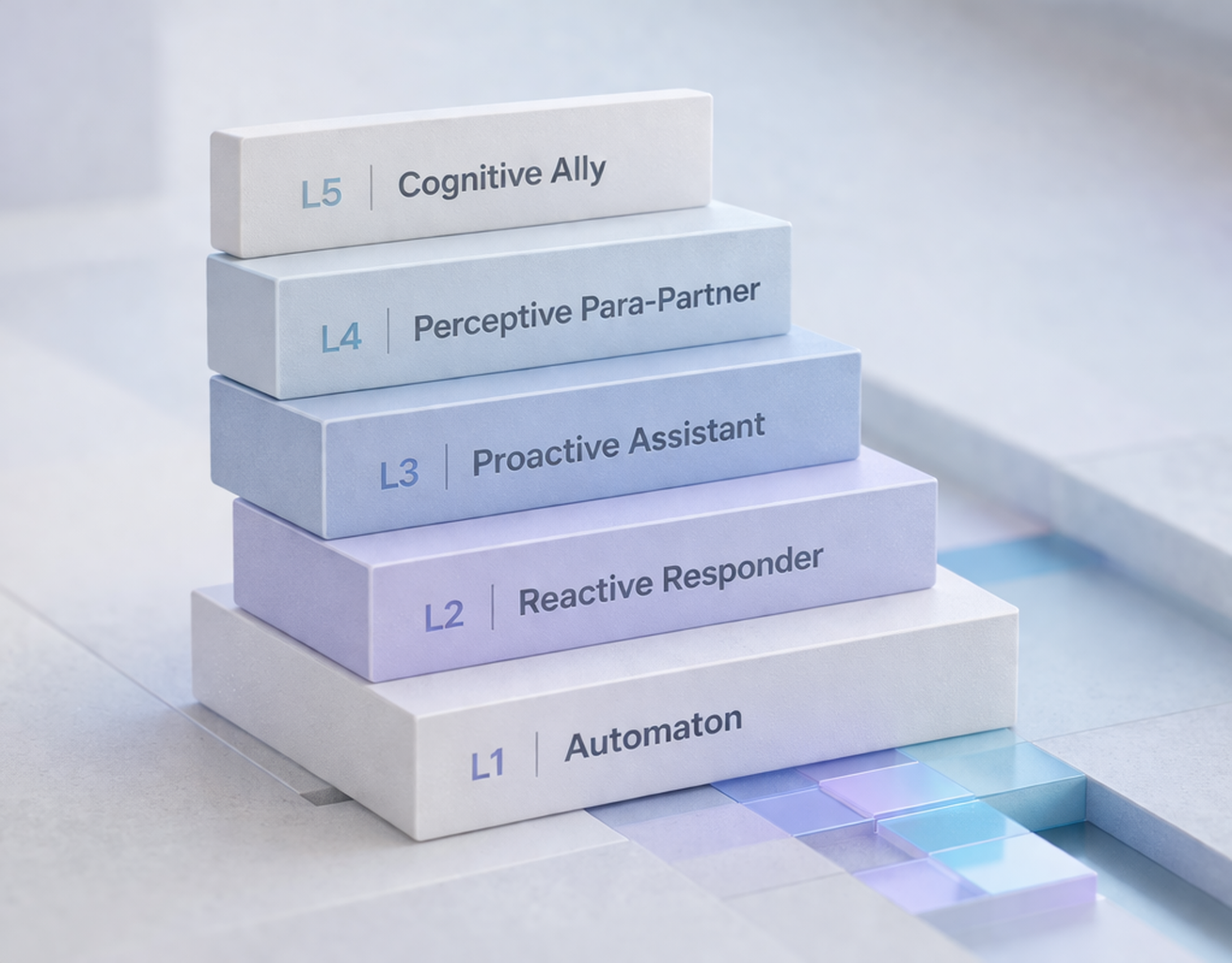
Not all AI agents are created equal. Similar to how autonomous driving is defined across levels of capability, AI agents can also be understood along a maturity curve, ranging from basic automation to highly intelligent, collaborative systems. We define this across five levels, based on the level of agency, autonomy, and corresponding machine intelligences required.
Level 1 – Automaton
These agents automate well-defined tasks (e.g., invoice processing or payment execution). They are efficient but rigid, with low tolerance for exceptions or ambiguity.
Level 2 – Reactive Responder
These agents respond to explicit human instructions and can handle some variability. However, they still rely on humans to guide them when situations fall outside predefined scenarios.
Level 3 – Proactive Assistant
These agents can take initiative. They detect anomalies, make decisions, and determine when to involve humans. This requires more advanced reasoning and interaction capabilities, such as interactional intelligence, to handle dynamic, real-world situations.
Level 4 – Perceptive Para-Partner
These agents demonstrate a deeper understanding of humans and their context, preferences, and personality. Powered by "personal intelligence," they can adapt interactions, hyper-personalize experiences, and support highly diverse, nuanced tasks by collaborating with humans.
Level 5 – Cognitive Ally (Future State)
At this level, agents become our cognitive allies, deeply integrated into our lives, acting as a cognitive "Her" to help us in many aspects of our lives. This remains an aspirational frontier.
Most vendors focus on Level 1 and Level 2, automation and basic responsiveness.
Our differentiation is enabling advanced AI agents (L3 & L4), agents that take initiative, adapt to real-world complexity, and collaborate effectively with humans.
We're not just help clients automate tasks, we're helping them build intelligent systems that can amplify and upskill their workforce, where the true differentiation comes from.
How is your platform different from other popular agent building tools or frameworks, such as OpenClaw, OpenAI Agents SDK, Anthropic Agent Skills, and LangChain/LangGraph?
Most agent-building tools and frameworks today are developer-centric. They require developers to write code to build AI agents from scratch, designing, orchestrating, and tuning agentic workflows, as well as monitoring agent behavior and building supporting interfaces and dashboards.
In contrast, our platform is designed for both business and technical users. It enables non-IT professionals (e.g., marketers, sales professionals, and instructors) and developers alike to rapidly build and safely operate AI agents using no-code and low-code, significantly reducing the time and effort required to move from idea to production.
Most existing tools are also generative-centric, relying heavily on large language models (LLMs) to manage agent behavior.
We take a different approach, a task-centric, hybrid AI framework. Our platform represents agentic workflows using a generalized hierarchical task network (GHTN), which serves as the structural "spine" of the agent. LLMs complement this structure by providing flexibility and adaptability (the "flesh" and "blood").
As a result, our AI agents combine symbolic AI and classical algorithms to ensure task reliability, safety, and compliance, while leveraging LLMs to enable dynamic, context-aware behavior. Our GHTN also enforces a disciplined approach to context engineering: LLM usage is distributed across individual tasks to guide agent behavior at a fine-grained, contextual level. This makes much easier to tune an AI agent and avoids the "whack-a-mole" effect often seen in purely generative approaches.
How are your agentic solutions different from co-pilot?
Co-pilot as-is is not an agentic AI solution as it does not have a particular goal in mind and it lacks agency: it requires humans to drive every step in order to achieve a goal. It does not have your corporate data and knowledge (e.g., business processes and corporate knowledge) so it is not customized to help you (e.g., automating your business processes with your business knowledge). In contrast, the AI agentic solutions we offer are AI agents that can automatically accomplish higher-level goals that often involve completing multiple tasks/steps. For example, it requires an AI agent to automatically complete multiple tasks including collaborating with humans (e.g., a sales person or a prospective customer) to achieve the goal of coaching your salesperson to formulate a strategy on selling a new product or proactively guiding your prospects to navigate your product options. Such an AI agent is intended to augment your workforce and enable it achieve more and better results, directly impacting your business outcomes (e.g., selling more products in shorter time periods or converting more prospects with less resources).
What are the deployment options do you support for your agentic solutions?
We support four deployment options:
- Public cloud (hosted by Accenture or ecosystem partners such as AWS, GCP, and Microsoft Azure)
- Private cloud (hosted and managed by Accenture or ecosystem partners)
- Hybrid cloud (hosted and managed by Accenture or ecosystem partners)
- On-premise (deployed on clients’ internal infrastructure or local environments)
How is your offer different from other offerings such as IBM Enterprise Advantage (watsonx Orchestrate), Google Dialog Flow, Microsoft Copilot Studio, or other agentic AI platforms?
Our offering is highly differentiating from the following aspects:
- Accenture’s leadership in human-centered approach to AI to power human-AI fused enterprises and future-proofing talents and business vitality
- Our superior, comprehensive tooling creates faster outcomes, and lower total cost of ownership
- Our hybrid agentic AI (gen AI + cognitive AI) advantage optimizes AI task performance and user experience, and ensures AI safety and compliance, all at the same time
- Our open, extensible platform offers an edge to enable faster innovation and more sustainable ROI
How is your offer working with our ecosystem partners, such as Google, Open AI, Anthropic, Microsoft, and Amazon?
Our agentic AI platform and solutions work well with all major cloud providers (e.g., AWS, Microsoft Azure, and GCP), leverage one or more foundational large language models (e.g., GPT, Gemini, Claude), and can be easily integrated with any third-party software (e.g., CRM) and platforms (e.g., data platforms).
How do we keep your information safe?
We take data security seriously. Our platform is designed with enterprise-grade security controls, including role-based access, encryption in transit and at rest, and compliance with major regulatory standards. We work with your security and legal teams to ensure deployment meets your organization’s requirements.